EverOS vs Mem0 Benchmark Comparison
EverOS vs Mem0 Benchmark Comparison
This article delves into various aspects of both platforms, examining essential metrics, user experiences, and unique functionalities.
EverMind researchers
About 3 minutes to read

In the competitive landscape of AI productivity tools, comparing benchmarks such as EverOS and Mem0 provides insights into their performance and usability. This article delves into various aspects of both platforms, examining essential metrics, user experiences, and unique functionalities. By understanding these comparisons, users can make informed decisions about which tool best aligns with their needs. This exploration addresses critical points, including performance metrics, user experiences, and key differences in functionality. The following sections will offer concise, data-backed evaluations and highlight the practical implications for users in real-world applications. Learn more about the core philosophy behind these tools at "Evermind AI's mission".
Performance Metrics
Performance metrics serve as a critical benchmark for evaluating AI tools. They provide a quantifiable basis for comparison, enabling users to assess effectiveness. Various studies and assessments guide which metrics are most relevant for platforms like EverOS and Mem0. Evaluating scores can help prospective users determine the value each platform adds to their workflows. For a deeper understanding of the underlying technology, exploring "EverOS technology" is recommended.
Benchmark Results
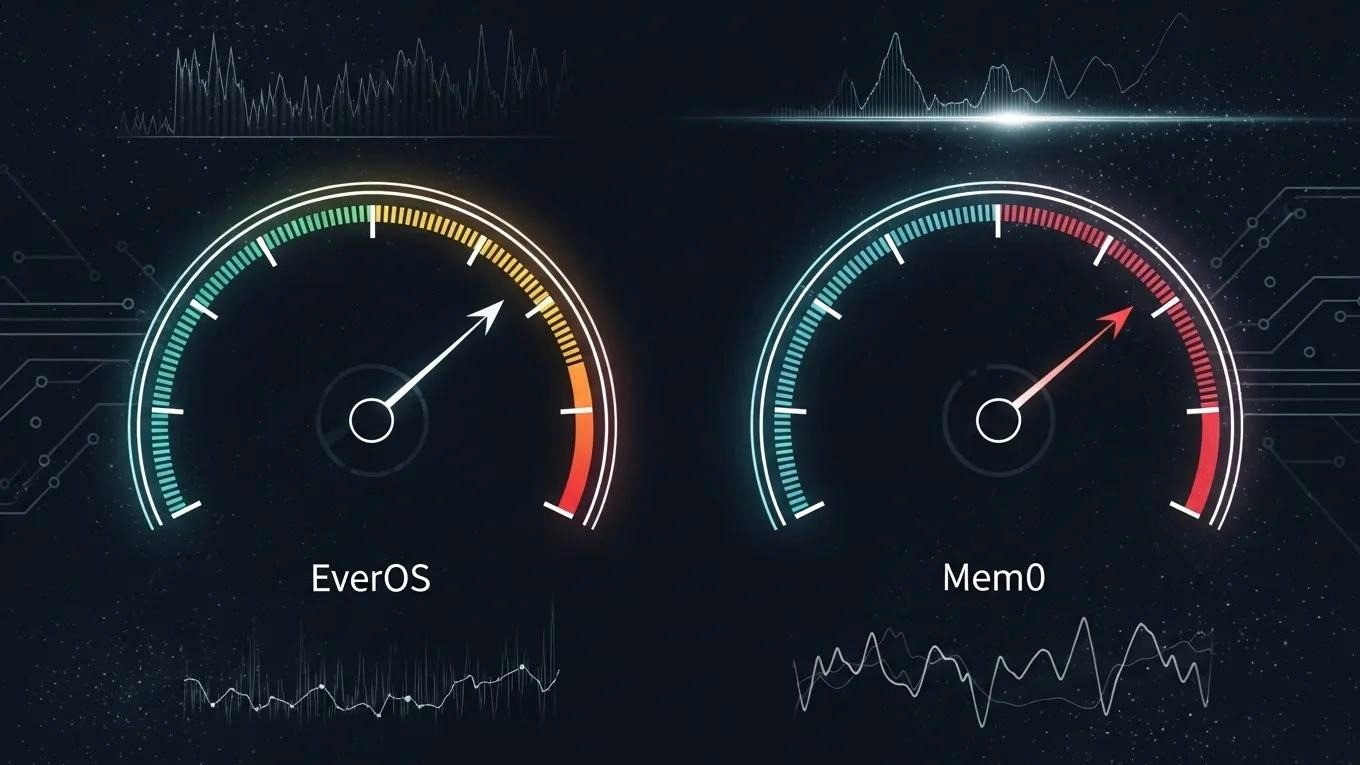
The following table showcases the benchmark scores of EverOS and Mem0 in notable evaluations:
Benchmark Test | EverOS Score | Mem0 Score |
|---|---|---|
LoCoMo Benchmark | 93.05% | 76.00% |
LongMemEval-S | 83.00% | 49.0% |
The data indicates that EverOS consistently outperforms Mem0 across multiple testing scenarios. This might suggest a more robust processing capability and efficiency in handling tasks.
User Experiences

User feedback plays a vital role in understanding the practical applications and user-friendliness of AI productivity tools. Both EverOS and Mem0 come with unique user experiences, affecting user satisfaction and overall productivity.
AI for Productivity in UX Design
to improve productivity within the professional practices of designers. This paper looks at the use of AI for productivity and explores whether the routine tasks of UX design could be Can Artificial Intelligence be used to improve productivity by automating elements of the User Experience design processes?, N Choudhury, 2023
EverOS vs Mem0 User Insights
EverOS's Structured Memory Lifecycle: Users benefit from a carefully managed memory lifecycle that promotes seamless data retrieval and effective memory management, significantly enhancing workflow efficiency.
Mem0's Simplicity for Basic Tasks: While quick to implement, Mem0 is often praised for its simplicity with basic memory tasks, though it might lack the advanced features found in EverOS.
These reviews reveal a distinct preference for EverOS among users requiring sophisticated features while pointing out that Mem0 may suffice for users with simpler needs.
Key Differences in Functionality
Understanding the fundamental differences in functionality between EverOS and Mem0 is essential for users to select the most appropriate tool for their objectives.
Memory Architecture Comparison
EverOS employs a four-layer architecture: EverOS employs a four-layer architecture that resembles concepts found in the MSA memory model, where memory is organized into structured layers for storage, retrieval, consolidation, and adaptive learning.
Mem0 operates as a passive memory layer: Its limited architecture can restrict scalability and advanced feature integration, potentially impacting productivity for users with demanding requirements.
The architectural designs indicate that EverOS may offer a more extensive set of tools for sophisticated productivity needs, whereas Mem0 maintains a focus on simplicity.
In summary, the comparison between EverOS and Mem0 highlights significant differences in performance, user experiences, and functional capabilities. EverOS demonstrates clear advantages in processing efficiency and advanced user features, making it suitable for larger enterprises requiring robust solutions. Conversely, Mem0 might appeal to those seeking simplicity and ease of implementation for basic applications. Businesses looking for AI tools should evaluate their specific needs and consider the distinct advantages offered by EverOS. If benchmark speed matters but durable memory matters more, explore Evermind for a deeper look at long-horizon agent performance.
What Are the Key EverOS Benchmark Results Compared to Mem0?
The benchmark findings outlined earlier provide a clear picture of how EverOS outperforms Mem0 in measurable metrics. With EverOS achieving scores of 93.05% and 83.00% in key assessments compared to Mem0's significantly lower figures, it’s evident which platform offers superior performance.
How Does EverOS Speed and Efficiency Outperform Mem0?
EverOS's technology supports superior dynamic memory management, which enables it to handle complex workloads more effectively than Mem0, whose passive approach may hinder performance in prolonged or resource-intensive tasks.
Which AI Productivity Features Does EverOS Offer That Surpass Mem0?
EverOS incorporates dynamic memory allocation and enhanced contextual awareness, features that significantly contribute to its efficiency and user satisfaction, while Mem0 lacks similar depth in its functionalities.
How Do EverOS and Mem0 Integrate with Enterprise AI Systems?
Both systems provide integration capabilities with enterprise-level AI systems, but EverOS supports various storage backends, enhancing compatibility, while Mem0 tends to have a simpler, more limited integration process.
What ROI Benefits Do Businesses See from EverOS Versus Mem0?
Businesses that adopt EverOS report increased user engagement and substantial cost savings, primarily due to the platform's efficiency and robust functionality. In contrast, Mem0 does not consistently reflect the same level of return on investment.
How Does Mem0’s Integration Compare in Real-World Applications?
While Mem0 offers straightforward integration for basic applications, it falls short in more complex scenarios compared to EverOS, which demonstrates strong adaptability across various enterprise needs, making it a preferred choice for non-trivial implementations.
What Are the Pricing Differences Between EverOS and Mem0?
Mem0 provides tiered pricing plans, including Free, Starter, and Pro plans, which makes it accessible for diverse user needs. On the other hand, EverOS is not fully open-source, which may affect organizations' decisions based on cost and feature accessibility.
In the competitive landscape of AI productivity tools, comparing benchmarks such as EverOS and Mem0 provides insights into their performance and usability. This article delves into various aspects of both platforms, examining essential metrics, user experiences, and unique functionalities. By understanding these comparisons, users can make informed decisions about which tool best aligns with their needs. This exploration addresses critical points, including performance metrics, user experiences, and key differences in functionality. The following sections will offer concise, data-backed evaluations and highlight the practical implications for users in real-world applications. Learn more about the core philosophy behind these tools at "Evermind AI's mission".
Performance Metrics
Performance metrics serve as a critical benchmark for evaluating AI tools. They provide a quantifiable basis for comparison, enabling users to assess effectiveness. Various studies and assessments guide which metrics are most relevant for platforms like EverOS and Mem0. Evaluating scores can help prospective users determine the value each platform adds to their workflows. For a deeper understanding of the underlying technology, exploring "EverOS technology" is recommended.
Benchmark Results
The following table showcases the benchmark scores of EverOS and Mem0 in notable evaluations:
Benchmark Test | EverOS Score | Mem0 Score |
|---|---|---|
LoCoMo Benchmark | 93.05% | 76.00% |
LongMemEval-S | 83.00% | 49.0% |
The data indicates that EverOS consistently outperforms Mem0 across multiple testing scenarios. This might suggest a more robust processing capability and efficiency in handling tasks.
User Experiences
User feedback plays a vital role in understanding the practical applications and user-friendliness of AI productivity tools. Both EverOS and Mem0 come with unique user experiences, affecting user satisfaction and overall productivity.
AI for Productivity in UX Design
to improve productivity within the professional practices of designers. This paper looks at the use of AI for productivity and explores whether the routine tasks of UX design could be Can Artificial Intelligence be used to improve productivity by automating elements of the User Experience design processes?, N Choudhury, 2023
EverOS vs Mem0 User Insights
EverOS's Structured Memory Lifecycle: Users benefit from a carefully managed memory lifecycle that promotes seamless data retrieval and effective memory management, significantly enhancing workflow efficiency.
Mem0's Simplicity for Basic Tasks: While quick to implement, Mem0 is often praised for its simplicity with basic memory tasks, though it might lack the advanced features found in EverOS.
These reviews reveal a distinct preference for EverOS among users requiring sophisticated features while pointing out that Mem0 may suffice for users with simpler needs.
Key Differences in Functionality
Understanding the fundamental differences in functionality between EverOS and Mem0 is essential for users to select the most appropriate tool for their objectives.
Memory Architecture Comparison
EverOS employs a four-layer architecture: EverOS employs a four-layer architecture that resembles concepts found in the MSA memory model, where memory is organized into structured layers for storage, retrieval, consolidation, and adaptive learning.
Mem0 operates as a passive memory layer: Its limited architecture can restrict scalability and advanced feature integration, potentially impacting productivity for users with demanding requirements.
The architectural designs indicate that EverOS may offer a more extensive set of tools for sophisticated productivity needs, whereas Mem0 maintains a focus on simplicity.
In summary, the comparison between EverOS and Mem0 highlights significant differences in performance, user experiences, and functional capabilities. EverOS demonstrates clear advantages in processing efficiency and advanced user features, making it suitable for larger enterprises requiring robust solutions. Conversely, Mem0 might appeal to those seeking simplicity and ease of implementation for basic applications. Businesses looking for AI tools should evaluate their specific needs and consider the distinct advantages offered by EverOS. If benchmark speed matters but durable memory matters more, explore Evermind for a deeper look at long-horizon agent performance.
What Are the Key EverOS Benchmark Results Compared to Mem0?
The benchmark findings outlined earlier provide a clear picture of how EverOS outperforms Mem0 in measurable metrics. With EverOS achieving scores of 93.05% and 83.00% in key assessments compared to Mem0's significantly lower figures, it’s evident which platform offers superior performance.
How Does EverOS Speed and Efficiency Outperform Mem0?
EverOS's technology supports superior dynamic memory management, which enables it to handle complex workloads more effectively than Mem0, whose passive approach may hinder performance in prolonged or resource-intensive tasks.
Which AI Productivity Features Does EverOS Offer That Surpass Mem0?
EverOS incorporates dynamic memory allocation and enhanced contextual awareness, features that significantly contribute to its efficiency and user satisfaction, while Mem0 lacks similar depth in its functionalities.
How Do EverOS and Mem0 Integrate with Enterprise AI Systems?
Both systems provide integration capabilities with enterprise-level AI systems, but EverOS supports various storage backends, enhancing compatibility, while Mem0 tends to have a simpler, more limited integration process.
What ROI Benefits Do Businesses See from EverOS Versus Mem0?
Businesses that adopt EverOS report increased user engagement and substantial cost savings, primarily due to the platform's efficiency and robust functionality. In contrast, Mem0 does not consistently reflect the same level of return on investment.
How Does Mem0’s Integration Compare in Real-World Applications?
While Mem0 offers straightforward integration for basic applications, it falls short in more complex scenarios compared to EverOS, which demonstrates strong adaptability across various enterprise needs, making it a preferred choice for non-trivial implementations.
What Are the Pricing Differences Between EverOS and Mem0?
Mem0 provides tiered pricing plans, including Free, Starter, and Pro plans, which makes it accessible for diverse user needs. On the other hand, EverOS is not fully open-source, which may affect organizations' decisions based on cost and feature accessibility.
You may also like these
Related

Multi-round retrieval: letting the model decide when to stop searching
multi-round retrieval,agentic retrieval,fixed top-k,injection budget,core selection,EverOS,agent memory,LoCoMo,LongMemEval,EverMemBench,SubtleMemory,multi-hop retrieval,retrieval accuracy,prompt token cost

Do public SKILL.md files actually make agents better?
SkillCorpus,SKILL.md,agent skills,skill curation,skill retrieval,LLM agents,SkillsBench,GDPVal,agent harness

CRAFT: learning how to fuse video tokens, not just which to drop
CRAFT,video token compression,vision-language models,video VLM,KV cache,prefill cost,token merging,token pruning,temporal reasoning

Self-evolving agents have a measurement problem
self-evolving agents,agent harness,HarnessBank,credit assignment,LLM agents,agent evaluation,harness optimization,significance testing
EverOS vs Mem0 Benchmark Comparison
This article delves into various aspects of both platforms, examining essential metrics, user experiences, and unique functionalities.
EverMind researchers
About 3 minutes to read
EverMind
A straightforward solution to long-term coherence
Scan to join the community

Discord


© 2026 EverMind Team.
EverMind
A straightforward solution to long-term coherence
Scan to join the community
Discord
© 2026 EverMind Team.
EverMind
A straightforward solution to long-term coherence
Scan to join the community
Discord
© 2026 EverMind Team.