Claude Code Memory Plugin for Persistent Developer Context
Give Claude Code and coding agents a memory plugin layer that remembers repo conventions, past fixes, architectural decisions, and workflow history across sessions.
$ claude --resume # recalled: 17 decisions · 42 conventions · 9 reusable patterns
› "fix the migration script" # remembers: prior rollback, naming rule, test gate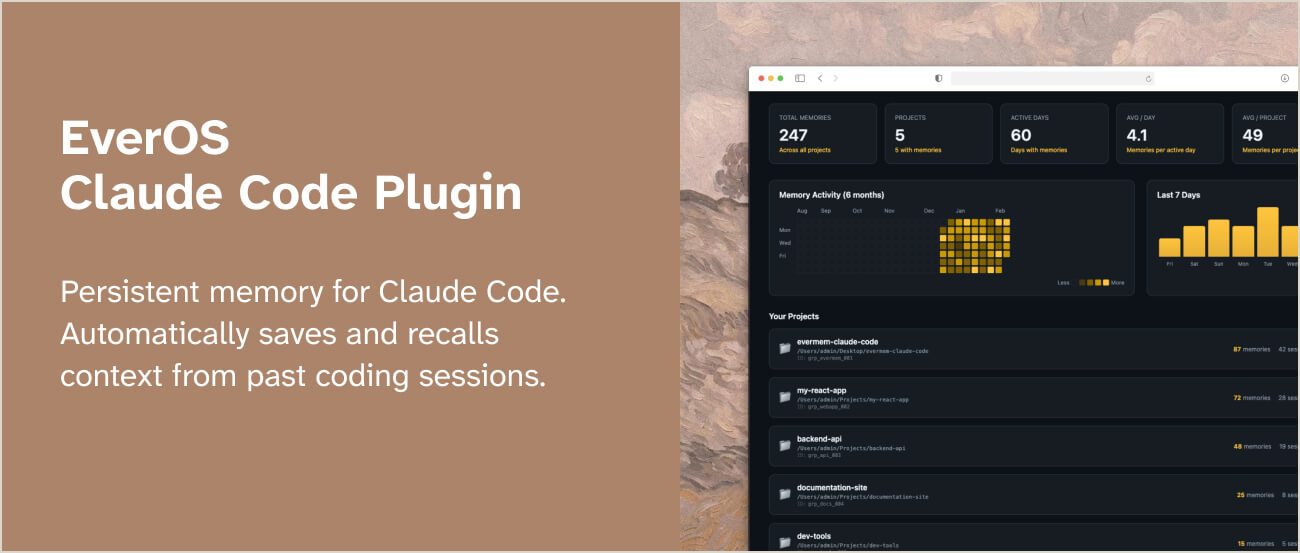
Why developers keep repeating themselves to coding agents
Coding agents are useful until the session ends. Then the repo context, prior decisions, and implementation history disappear.
Developers repeat the same instructions, the agent rediscovers the same files, and consistency starts slipping. The agent isn't dumb — it's just stateless.
A Claude Code memory plugin should do more than retrieve snippets. It should preserve durable engineering context that remains useful across days, branches, and repeated tasks.
What a real code memory plugin should remember
Four kinds of durable context that need to survive between sessions.
Repository conventions
Naming rules, architecture patterns, test expectations, deployment quirks, and file locations.
Decision history
Why a fix was chosen, what tradeoff was accepted, and what should not be changed casually.
Reusable task patterns
How the agent usually handles a migration, test workflow, bug triage, or documentation update.
Developer-specific context
Preferred coding style, review expectations, and environment-specific notes when appropriate.
How Evermind supports Claude Code memory
Evermind provides the memory layer underneath the coding workflow.
Long-term memory beyond retrieval
Instead of only searching files, EverOS can maintain structured memory about decisions, workflows, and repo-specific knowledge.
File, CLI, and environment-aware context
Strong developer intent around CLI usage, files, debugging, logging, symlinks, and environment variables — all addressable through structured memory.
Case-to-skill learning for repeated dev work
When a team handles the same class of tasks repeatedly, EverOS captures those patterns and turns them into reusable skills.
Inspectable memory through Memory Bank
Developers should be able to see and manage what the system remembers instead of trusting a hidden state layer.
Best-fit use cases
Where persistent developer context produces the most leverage.
Large codebases
Agents stop wasting time rediscovering architecture and can preserve working knowledge across sessions.
Multi-agent development workflows
One agent can debug, another can test, and another can document while sharing the right memory — without forcing everything into one prompt.
Ongoing maintenance
Recurring issues, previous patches, and known edge cases remain accessible instead of being relearned from logs every time.
Toolchain continuity
Memory can support workflows spanning editors, CLIs, repos, tickets, and documentation — not just a single chat surface.
Memory plugin vs plain code retrieval
The difference matters when the work is iterative, stateful, and collaborative.
"Where is the relevant file?"
Answers point-in-time questions about the repo. Resets every session.
"What happened before, why was this decision made, what pattern already worked, and what should the agent do next?"
Carries durable engineering context across sessions, branches, and agents.
What teams ask before adopting
The three objections we hear most often — and the honest answers.
Is memory just bigger context?
No. Bigger context only delays forgetting. Memory preserves useful knowledge across sessions.
Will this become noisy?
Not if memory is structured, filtered, and inspectable. Evermind is designed to manage memory instead of blindly appending it.
Does this help outside Claude Code?
Yes. The same memory layer can support broader coding-agent and developer-tool workflows.
Frequently Asked Questions
What is a Claude Code memory plugin?
It is a memory layer that helps Claude Code or similar coding agents retain repo-specific context, decisions, and repeated workflow knowledge across sessions.
How is this different from a vector search over the repo?
Vector search helps retrieve code. Memory adds durable context about decisions, behaviors, and prior execution history — knowledge that doesn't live in any single file.
Can this reduce repeated prompting?
Yes — that's one of the clearest benefits. The agent can reuse stored context instead of asking the same setup questions every day.
Can teams inspect what the agent remembers?
Yes. Evermind's Memory Bank is designed to make memory transparent and manageable — you can review, edit, or remove anything that's been stored.
The missing layer for coding agents
If your coding agent is technically capable but operationally forgetful, a Claude Code memory plugin is the missing layer. Evermind helps developer workflows accumulate useful context instead of losing it every session.