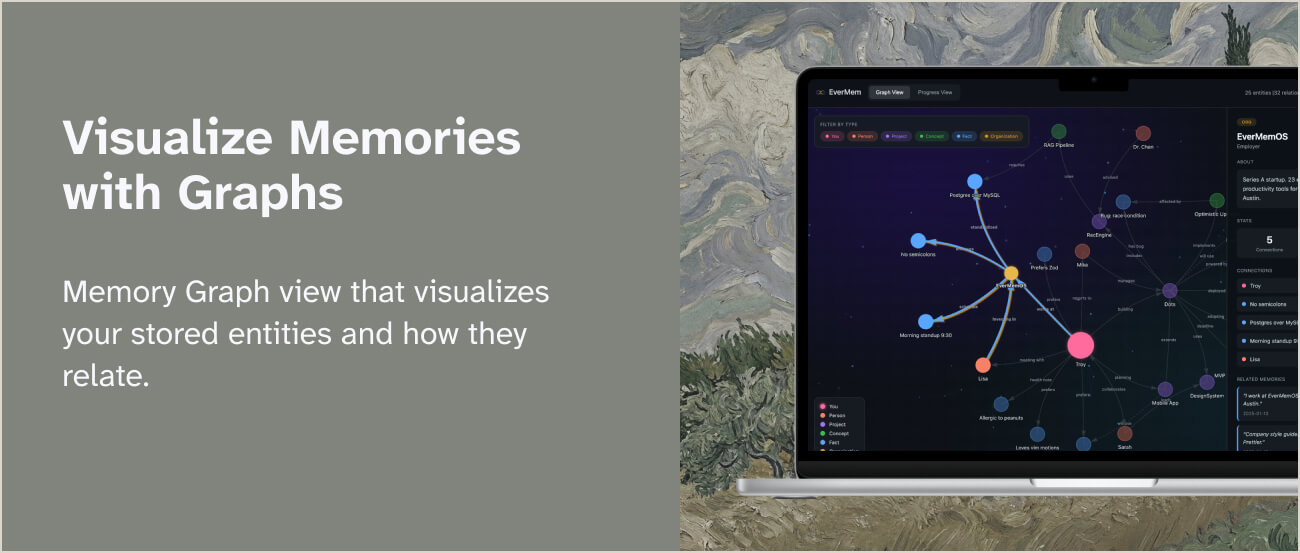
Use Case · Memory Graph

Memory Graph for AI Agents That Need More Than Vector Search

Build graph-based memory for AI agents so they can connect entities, events, and temporal context — instead of retrieving isolated chunks with weak reasoning.

Memory graph for AI agents — overview

Why vector-only memory breaks down

Vector retrieval is useful, but it is not enough for many agent systems. When the agent needs to connect people, events, goals, tasks, and time-sensitive facts, plain chunk similarity starts missing the real relationship structure.

That's why technical buyers look for a memory graph for AI agents. A graph-based memory layer helps agents:

  • Connect related entities and facts
  • Support multi-hop retrieval
  • Track how information changes over time
  • Preserve richer context for reasoning
  • Expose clearer structure than a flat store

What a memory graph should represent

Four building blocks that move memory from flat text overlap to structured meaning.

Entities

Users, agents, teams, documents, tasks, products, tools, and knowledge objects.

Relationships

Who did what, what depends on what, what belongs together, and what changed.

Temporal context

When a fact was true, when it was updated, and whether it should override older memory.

Abstractions

Patterns, summaries, and learned structures that help the agent retrieve meaning instead of just text overlap.

How Evermind approaches graph-based memory

Evermind gives teams a structured long-term memory system that organizes memory into relationships — architecture depth, not surface-level retrieval.

01 · Structure

Structured memory organization

Memory is organized in a way that supports retrieval paths, not just nearest-neighbor matches.

02 · Reasoning

Better multi-hop reasoning

When a task depends on linked facts across several steps, a graph-oriented memory design provides more stable context.

03 · Inspectability

Inspectable memory relationships

Technical teams evaluating architecture want to understand how facts are connected and why a result was returned.

04 · Collaboration

Foundation for agent collaboration

Graph-based memory becomes even more valuable when multiple agents need to work across shared context.

Best-fit scenarios

Relationship-heavy, reasoning-heavy workflows where a graph earns its keep.

Research agents

Link papers, claims, benchmarks, citations, and evolving hypotheses.

Enterprise knowledge systems

Map documents, decisions, owners, and dependencies across teams.

Complex support workflows

Preserve customer history, product context, prior issues, and resolution chains.

Agentic product experiences

Maintain user goals, events, preferences, and workflow state across long-running journeys.

Memory graph vs vector store

Where each approach is strong — and why the best systems often combine them.

Vector-only approach Memory graph approach
Finds similar chunks Connects entities and relationships
Weak on multi-hop context Stronger for linked reasoning
Harder to track change over time Better temporal structure
Good for lookup Better for long-horizon decision workflows

The best systems often use hybrid strategies. Evermind's value is in treating memory as infrastructure, not just search.

Questions technical buyers ask

The architecture questions that come up in every serious evaluation.

?

Do we need to rebuild our whole stack?

Not necessarily. A good memory layer should integrate with the current agent architecture instead of forcing a full rewrite.

Can graph memory scale?

It can — if the system is designed around selective storage, retrieval discipline, and useful abstractions rather than naive graph expansion.

What about privacy and compliance?

Memory systems need governance, inspectability, and control over retained data — part of the architecture from day one.

Frequently Asked Questions

What is a memory graph for AI agents?

It is a structured memory model that stores entities, relationships, and temporal context so agents can retrieve linked knowledge more effectively.

Why is graph memory useful for multi-hop reasoning?

Because the agent can follow relationships across connected facts instead of relying on one-shot semantic similarity.

Is a graph better than a vector database?

Not universally. Graph memory is stronger for linked reasoning and relationship-heavy tasks. Vector retrieval is still useful for similarity search. Strong systems often combine both.

Can Evermind support technical evaluation of memory structure?

Yes. Evermind is positioned for teams that need structured, inspectable memory infrastructure rather than black-box recall.

Understand how facts connect — not just what looks similar

If your agent needs to reason over relationships, a memory graph is the right direction. Evermind gives teams a stronger foundation for long-horizon retrieval and reasoning.

EverMind

EverMind

EverMind

长期连贯性的直接解决方案

© 2026 EverMind 团队。

EverMind

长期连贯性的直接解决方案

© 2026 EverMind 团队。

EverMind

长期连贯性的直接解决方案

© 2026 EverMind 团队。