Best Zep Alternatives for AI Agent Memory in 2026: A Comprehensive Comparison
Best Zep Alternatives for AI Agent Memory in 2026: A Comprehensive Comparison
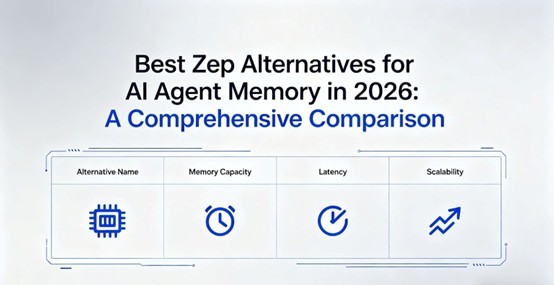
In this comprehensive guide, we explore the top alternatives to Zep in 2026—including Evermind.ai, Mem0, Letta, Cognee, and LangMem—comparing their architecture, benchmark performance, pricing, self-hosting path, and ideal use cases to help you make an informed decision.
EverMind researchers
About 3 minutes to read
In this comprehensive guide, we explore the top alternatives to Zep in 2026—including Evermind.ai, Mem0, Letta, Cognee, and LangMem—comparing their architecture, benchmark performance, pricing, self-hosting path, and ideal use cases to help you make an informed decision.
As AI agents move from short chatbot sessions into long-running workflows, memory infrastructure has become a product decision, not just an implementation detail. A memory layer now determines whether an agent can preserve user preferences, resolve contradictions, adapt to new facts, and recover relevant context without dragging the entire conversation history into every prompt.
Zep deserves credit for pushing this category forward. Its underlying open-source engine, Graphiti, is designed around temporal context graphs that track how facts change over time, preserve provenance through episodes, and support hybrid retrieval across semantic search, keyword search, and graph traversal. That model is powerful when an agent needs to answer questions such as “What did this customer prefer before the contract changed?” or “Which policy was valid at the time of the user’s request?”
The trade-off is that not every team wants to operate, pay for, or reason about a temporal graph system. In our work with long-term agent memory, we see teams look for a Zep alternative for three recurring reasons: they want more predictable cost, they need a simpler self-hosted deployment, or they want a memory architecture that manages conflicts, staleness, and personalization without requiring a graph database team.
Best Zep Alternatives for AI Agent Memory in 2026: A Comprehensive Comparison
The best Zep alternative depends on what you are trying to replace. If you are leaving Zep because you need temporal validity windows, you should compare against systems that can represent change over time. If you are leaving because of deployment complexity, you should focus on Docker-based or local-first systems. If your main pain is time-to-first-memory, a lighter memory SDK may be better than a full graph architecture.
A practical way to start is to identify the constraint that made you search for alternatives in the first place.
If your main reason for switching is... | Start your evaluation with... | Why this matters |
|---|---|---|
Credit-based pricing uncertainty | Evermind.ai, self-hosted Mem0, LangMem | Self-hosting or SDK-first memory avoids per-episode cost planning. |
Complex self-hosting | Evermind.ai, Mem0 | These options are easier to prototype than rebuilding a Zep-like stack around Graphiti and a graph backend. |
Deep temporal fact history | Zep or Evermind.ai | Temporal reasoning is not the same as simply timestamping memories. |
Fastest setup | Mem0 or LangMem | SDK-first systems can reach a working prototype quickly. |
Full autonomous agent runtime | Letta | Letta is not just a memory layer; it is an agent runtime with memory built in. |
Custom enterprise knowledge graph | Cognee | Cognee emphasizes custom knowledge infrastructure, ingestion, graph/vector search, and traceability. |
Existing LangGraph stack | LangMem | LangMem is built for LangGraph’s storage and agent patterns. |
This article focuses on the five alternatives most relevant to engineering teams evaluating Agent Memory in production: Evermind.ai, Mem0, Letta, Cognee, and LangMem. Hindsight is also visible in the broader Zep alternatives landscape, especially for teams that want managed memory with observability, but the strongest direct comparisons for architecture, self-hosting, and developer control are the five tools below.
Why Are Developers Looking for a Zep Alternative?
Developers are usually not looking for a Zep alternative because Zep is weak. They are looking because Zep is specialized. Its temporal knowledge graph is a strong fit for time-sensitive memory, but that strength introduces cost, deployment, and conceptual trade-offs.
The first issue is pricing predictability. Zep Cloud has promoted a free tier with 1,000 credits per month, which is enough for API testing but often too small for real autonomous-agent prototyping. Teams building agents that continuously ingest chats, tool outputs, documents, or background events need to model not only user traffic but also write frequency, payload size, summarization behavior, and retrieval frequency. That can make credit budgeting difficult before production data exists.
The second issue is self-hosting complexity. Graphiti is open source under Apache 2.0 and is an impressive temporal graph engine. However, Graphiti is not the same thing as a complete managed memory platform. Its own documentation distinguishes Zep as managed context graph infrastructure and Graphiti as the open-source engine that requires your own surrounding implementation, tooling, and operations. Graphiti also depends on graph backends such as Neo4j, FalkorDB, Kuzu, or Amazon Neptune, plus LLM and embedding infrastructure.
The third issue is the learning curve. Temporal graph memory asks developers to reason about episodes, entities, facts, validity windows, supersession, provenance, retrieval ranking, and graph traversal. That is worthwhile for some use cases, but it is heavier than adding a memory SDK that stores and searches user preferences.
The final issue is memory lifecycle control. Retrieval is only half the problem. Production teams also need to ask what happens on the write path: how facts are extracted, how conflicts are resolved, how stale memories are retired, how sensitive data is deleted, and how tenant permissions are preserved. A good Zep alternative should be evaluated not only on search quality, but also on update, deletion, governance, and migration behavior.
Quick Comparison: Zep vs. Top Alternatives
Feature | Zep | Evermind.ai | Mem0 | Letta | Cognee | LangMem |
|---|---|---|---|---|---|---|
Core architecture | Temporal context graph | Engram-inspired memory lifecycle | Hybrid memory layer with vector, keyword, entity, and optional graph-style retrieval | Full stateful agent runtime | Memory control plane using embeddings, graphs, and knowledge infrastructure | LangGraph-native memory toolkit |
Best use case | Tracking fact changes over time | Deep long-term personalization and self-organizing memory | Fast implementation and broad framework integration | New autonomous agents that manage their own memory | Custom enterprise knowledge graphs and ingestion pipelines | LangGraph teams adding memory to existing agents |
Temporal reasoning | Strong validity-window model | Yes, as part of broader memory lifecycle | Current versions advertise time-aware retrieval, but not Zep-style validity windows | Via agent logic and memory design | Partial, depending on custom model | Not native validity windows |
Self-hosting | Graphiti engine only; full platform requires custom assembly | Simple self-hosted path | Library and self-hosted server available | Open-source runtime and API | Open-source, local/cloud options | SDK; storage backend is your responsibility |
License signal | Graphiti Apache 2.0 | Open-source core | Apache 2.0 | Apache 2.0 | Apache 2.0 | MIT |
Implementation effort | Medium to high | Low to medium | Low | Medium to high | Medium to high | Low if already using LangGraph |
Main risk | Operational complexity and credit planning | Younger ecosystem than some SDK-first tools | Benchmark and feature claims change quickly; graph memory differs by plan/version | Requires adopting the runtime | Requires careful data modeling | Tightly coupled to LangChain/LangGraph |
The most important distinction is this: Zep is best understood as managed temporal graph infrastructure, while most alternatives are either memory SDKs, agent runtimes, or knowledge infrastructure systems. If you compare only pricing or GitHub stars, you may choose the wrong tool. You need to compare the memory model.
1. Evermind.ai — Top Recommended Zep Alternative
Best for: Teams that need deep long-term personalization, temporal consistency, and a self-organizing memory system without the operational overhead of maintaining separate graph databases and memory pipelines.
Evermind offers an intelligent memory operating system called EverOS, designed to give AI agents the ability not just to remember, but to understand, reason, and evolve. While Zep focuses on tracking the temporal validity of individual facts, Evermind treats memory as a complete lifecycle: raw interactions are transformed into structured semantic memory, organized into adaptive memory scenes, and retrieved through a reconstruction process that aims to provide exactly the context an agent needs.
This is the main reason Evermind is our top Zep alternative. In practice, many memory failures do not happen because the system cannot find a relevant vector. They happen because the memory store becomes noisy. Old preferences remain next to new preferences. One-off facts are treated like durable identity information. Context is retrieved without understanding whether it is still useful. EverOS is designed around that lifecycle problem.
Architecture: The Four-Layer Memory OS
EverOS is built on a four-layer architecture that mirrors how human cognition separates sensing, indexing, long-term storage, and executive reasoning.
Layer | Function | Human brain analogy |
|---|---|---|
Agentic Layer | Task understanding, planning, and execution | Prefrontal cortex |
Memory Layer | Long-term storage, consolidation, and retrieval | Cortical memory networks |
Index Layer | Embeddings, key-value access, and knowledge graph indexing | Hippocampus |
API / MCP Interface Layer | Integration with external tools and enterprise systems | Sensory interface |
This architecture enables three practical advantages. First, the Memory Processor transforms memory from passive retrieval into active application, so stored knowledge can shape reasoning rather than merely appear in a context block. Second, Hierarchical Memory Extraction converts raw interactions into structured semantic units called MemCells, which can then be organized into adaptive memory graphs called MemScenes. Third, the Extensible Modular Memory Framework lets teams adapt strategies for different products, from enterprise copilots to companion AI.
How Evermind Handles Memory Retrieval
Unlike a pure graph-traversal approach, Evermind uses a three-phase process called Reconstructive Recollection. Candidate memories are first identified from the index layer. Then Memory Perception re-ranks those candidates by relevance, salience, and usefulness. Finally, Episodic Fusion assembles a compact memory bundle for the agent.
The practical benefit is that Evermind is not trying to stuff every matching record into the prompt. It is trying to reconstruct the smallest useful memory state. That matters in production, where token budget, latency, and memory quality all affect user experience.
Benchmark Performance: Where Evermind Outperforms Zep
Evermind’s published benchmark results report strong performance across long-dialogue memory QA, knowledge updates, temporal reasoning, and multi-facet long-context evaluation. The current article should keep those benchmark advantages, but with one important caveat: teams should validate memory systems against their own data, query patterns, model choices, and retrieval budgets. Memory benchmarks are useful directional evidence, but they are not a substitute for a workload-specific evaluation.
Benchmark | EverOS score | Zep score | Reported improvement |
|---|---|---|---|
LongMemEval-S | 83.00% | 63.8% | +19.2 points |
LoCoMo | 93.05% | 80.32% | +12.73 points |
For a buyer, the most useful interpretation is not just “which number is higher.” The question is whether the benchmark resembles the failure mode you care about. If your product needs long-term personalization, conflict resolution, and coherent memory across weeks or months, Evermind’s memory-lifecycle design is especially relevant.
Self-Hosting: Where Evermind Wins Decisively
Self-hosting is where Evermind becomes especially attractive as a Zep alternative. Graphiti can be self-hosted, but a full Zep-like system requires graph infrastructure, embedding and LLM services, retrieval orchestration, monitoring, and application-level governance. Evermind is designed to reduce that operational burden.
EverOS supports SQLite for local development and Postgres or vector database options such as FAISS, Milvus, and pgvector for production deployments. It is compatible with multiple LLM backends through API wrappers, including hosted and local models. For teams that need an air-gapped or private deployment, that simplicity can be more important than any single benchmark number.
Pricing
EverOS is open source and free to self-host. Enterprise managed cloud pricing is available on request through Evermind.ai. Unlike a credit-based managed service, the self-hosted version does not introduce per-operation memory charges. Your cost model is based on infrastructure, model usage, and operations rather than memory credits.
This difference matters most for autonomous agents that write memory frequently. A support agent, sales agent, or research agent may generate many memory events in the background. If you cannot predict write volume upfront, self-hosted memory can be easier to budget.
Verdict
Evermind.ai is the strongest overall Zep alternative for teams that need production-grade long-term memory without the operational complexity of assembling their own graph stack. It is especially compelling when the problem is not just “retrieve a memory,” but “maintain coherent, evolving knowledge about a user, workflow, or domain over time.”
That said, Evermind is not the right answer for every team. If you need Zep’s exact temporal validity-window model, Zep may still be the safer choice. If you only need a quick preference store for a weekend prototype, Mem0 may be faster. If you are building an entire new autonomous agent runtime, Letta may be more appropriate. Evermind is strongest when memory quality, long-term consistency, and operational simplicity matter together.
2. Mem0 — Best for Rapid Prototyping and Ecosystem Integration
Best for: Developers building consumer-facing assistants, chatbots, and agent prototypes who want the fastest path from zero to working memory.
Mem0 is one of the most widely recognized standalone memory layers. Its README describes it as an intelligent memory layer for personalized AI, with user, session, and agent memory, SDKs, and both self-hosted and managed deployment options. It is attractive because it is easy to adopt: developers can install the package, add memories, search them, and integrate with common agent frameworks quickly.
Architecture and Features
Mem0’s current architecture emphasizes multi-signal retrieval. Its 2026 README describes semantic retrieval, BM25 keyword matching, entity linking, and temporal reasoning in its newer algorithm. That is an important fact-check correction. Older comparisons sometimes claimed that Mem0 had no temporal reasoning at all. A more accurate statement is that Mem0 now advertises time-aware retrieval, but its defining data model is still different from Zep’s Graphiti-style temporal validity windows.
This distinction matters. Timestamp-aware retrieval can help a system prioritize recent or dated facts. A temporal graph validity model can represent when a fact became true, when it was superseded, and how facts changed over time. Those are related but not identical capabilities.
How Mem0 Compares to Zep
Mem0 is easier to set up than Zep and usually easier to explain to a product team. If your agent only needs to remember stable preferences such as “the user prefers dark mode,” “the customer uses Salesforce,” or “the buyer likes concise summaries,” Mem0 is a practical choice.
Zep is stronger when the question depends on historical state. For example, “What was the user’s preference before April?” or “Which vendor was responsible before the renewal?” requires more than a current memory. It requires a representation of change. That is where Zep’s temporal graph model remains differentiated.
Mem0 is therefore best viewed as a speed and ecosystem alternative rather than a direct replacement for every Zep use case. It is excellent for quick implementation, personalization, and framework integration, but teams should test conflict handling, deletion behavior, and temporal queries before using it for regulated or time-sensitive workflows.
3. Letta (formerly MemGPT) — Best for Autonomous Agent Runtimes
Best for: Teams building long-running autonomous agents from scratch who want memory management to be part of the agent runtime itself.
Letta takes a fundamentally different approach. Rather than offering only a passive memory layer, Letta provides a stateful agent runtime with memory built into the agent architecture. Its README describes Letta as a way to build AI with advanced memory that can learn and self-improve over time, with API and SDK support for stateful agents.
Architecture: OS-Inspired Memory Management
Letta’s memory model is inspired by operating-system concepts. Agents can maintain always-available core memory, searchable archival memory, and conversation recall. The key difference from Zep is that memory is not merely retrieved by an external service. The agent participates in managing its own memory.
Tier | Description | OS analogy |
|---|---|---|
Core Memory | Always in context and immediately available | RAM |
Archival Memory | External searchable long-term store | Hard disk |
Recall Memory | Searchable conversation history | Recent files cache |
This design is powerful for agents that need to decide what to keep, what to archive, and what to retrieve later. It is also more opinionated. If you already have an agent stack built on another framework, adopting Letta may require a larger architectural shift than adopting a standalone memory API.
How Letta Compares to Zep
Zep is a memory infrastructure layer. Letta is closer to a complete agent runtime. That makes Letta a poor drop-in replacement for teams that simply want to swap out a memory API, but a strong option for teams starting fresh.
A fact-check update is also worth noting: Letta’s current GitHub license is Apache 2.0, not MIT. Its pricing page states that Letta Code can be used for free with your own API keys, and lists a Pro personal plan at $20 per month with usage quotas and up to 20 stateful agents. Because managed-plan details can change, teams should confirm current limits directly before purchase.
Letta is the right choice if your question is not “Which memory layer should I plug into my agent?” but “Which runtime should I build my agent on?”
4. Cognee — Best for Custom Knowledge Graph Infrastructure
Best for: Data-heavy applications where developers need granular control over ingestion, custom entities, graph structure, and local-first knowledge infrastructure.
Cognee describes itself as an open-source memory control plane for agents that ingests data in many formats, combines embeddings, graphs, and cognitive-science approaches, and provides the right context as data changes. It is a strong choice when your memory problem looks less like user preference storage and more like enterprise knowledge modeling.
Cognee’s positioning is broader than Zep’s. Zep is optimized around agent memory and temporal context graphs. Cognee is more like a knowledge infrastructure layer that can support agents, documents, workflows, and domain-specific entity models.
How Cognee Compares to Zep
Zep gives you a more opinionated temporal memory architecture. Cognee gives you more control over the shape of the knowledge layer. That makes Cognee attractive for teams that need custom ontologies: healthcare relationships, finance ownership chains, legal matter graphs, technical support taxonomies, or internal knowledge systems with strict tenant boundaries.
Cognee’s README also emphasizes traceability, user or tenant isolation, audit traits, local/cloud options, and a managed cloud path. Those are important buyer criteria that many memory comparisons ignore. For enterprise memory, the question is not only whether the agent can remember. The question is whether the system can prove where a memory came from, who can access it, and how it can be removed.
Cognee is more complex than a lightweight SDK, but that complexity buys flexibility. Choose it when you want to design the knowledge model yourself. Do not choose it if your top priority is the fastest possible implementation.
5. LangMem — Best for LangChain/LangGraph Teams
Best for: Teams already running LangChain or LangGraph who want long-term memory without introducing a separate memory platform.
LangMem helps agents learn and adapt from interactions over time. Its README says it provides tools to extract important information from conversations, optimize behavior through prompt refinement, and maintain long-term memory, with native integration into LangGraph’s storage layer.
LangMem’s advantage is ecosystem fit. If your agent is already built on LangGraph, LangMem feels natural. It can provide memory tools the agent uses during active conversations and background memory management that extracts, consolidates, and updates knowledge over time.
How LangMem Compares to Zep
LangMem is not a direct Zep replacement for every architecture. It does not provide Zep-style temporal validity windows as a native memory model, and production persistence depends on the storage backend you choose. The README explicitly notes that in-memory storage is for development and that production systems should use a database-backed store such as Postgres.
The right way to think about LangMem is: if you already use LangGraph, it is probably the path of least resistance. If you are not in the LangChain ecosystem, adopting LangMem may create more coupling than you want.
LangMem is licensed under MIT. It is a strong developer tool, but it is best evaluated as part of a LangGraph architecture rather than as a standalone managed memory service.
Pricing Comparison at a Glance
Pricing in this category changes quickly, and self-hosted options shift cost from subscription fees to infrastructure and operations. The table below should be treated as a buyer’s orientation, not as a substitute for checking each vendor’s current pricing page.
Tool | Free tier or OSS option | Entry paid plan | Pricing note |
|---|---|---|---|
Zep | Free tier advertised at 1,000 credits/month | Credit-based managed plans | Good for managed temporal memory; budgeting depends on write and retrieval volume. |
Evermind.ai | Free OSS self-hosted option | Enterprise managed pricing on request | Self-hosting avoids per-memory-operation charges. |
Mem0 | Library and self-hosted options | Managed tiers vary by plan | Strong for quick adoption; verify graph memory and compliance limits by current plan. |
Letta | Free with own API keys | Pro personal plan listed at $20/month | BYOK supported; API and personal-plan usage models differ. |
Cognee | Open-source self-hosting | Managed cloud options | Best evaluated by deployment model, data volume, and support needs. |
LangMem | Free SDK | LangGraph/LangSmith platform costs may apply | SDK is free; production hosting and observability depend on your stack. |
For cost-sensitive teams, the key comparison is not just monthly subscription price. It is the total cost of memory writes, retrieval calls, embeddings, LLM extraction, database storage, observability, deletion workflows, and engineering time.
Who Should Use Which Tool?
The clearest way to choose is to map the tool to the job rather than to the category label.
User profile | Recommended tool | Reason |
|---|---|---|
Building a personalized AI assistant with evolving user knowledge | Evermind.ai | Strong long-term memory design, simple self-hosting, and benchmark-led positioning. |
Need precise tracking of how facts change over time | Zep | Mature temporal context graph with validity-window modeling. |
Want the fastest setup and broad framework integrations | Mem0 | SDK-first memory layer with strong ecosystem adoption. |
Starting fresh with a full autonomous agent runtime | Letta | Stateful agents manage memory as part of the runtime. |
Need custom knowledge graphs with domain-specific entities | Cognee | Flexible knowledge infrastructure, ingestion, graph/vector search, and traceability. |
Already running LangChain or LangGraph | LangMem | Native fit with LangGraph storage and agent tools. |
A useful internal test is to ask three questions before switching from Zep. First, do you need to preserve historical truth, or only current preference? Second, do you need a managed platform, or can your team operate memory infrastructure? Third, are you replacing only memory, or are you willing to change the entire agent runtime?
Migrating from Zep: A Practical Checklist
A migration should not start with a vendor comparison table. It should start with your memory data model.
Migration step | What to decide | Why it matters |
|---|---|---|
Inventory users, sessions, and episodes | Which Zep episodes map to user memories, task memories, or domain facts? | Prevents dumping raw history into a new system without structure. |
Decide temporal-history requirements | Do you need old facts, current facts, or both? | Determines whether you need Zep-like validity windows. |
Map write-path behavior | How will the new system update, merge, delete, or supersede memories? | Avoids contradiction and stale-memory drift. |
Test retrieval quality | Use real queries, edge cases, and old/new preference conflicts. | Benchmarks rarely match your exact workload. |
Check privacy and deletion | Confirm tenant isolation, export, purge, and right-to-be-forgotten behavior. | Required for enterprise and regulated deployments. |
Estimate production cost | Include embeddings, LLM extraction, storage, retrieval, and engineering operations. | Subscription price alone is misleading. |
This checklist is especially important if your current Zep usage depends on temporal relationships. A simple memory store may appear to work during early testing but fail when a user asks about prior states, policy versions, or relationship changes.
Frequently Asked Questions
What is the main difference between Zep and Evermind.ai?
Zep focuses on temporal context graphs that track how individual facts change over time. Evermind.ai uses an engram-inspired memory lifecycle architecture that structures raw interactions into semantic memory units and adaptive memory scenes. In practical terms, Zep is strongest when historical validity windows are the core requirement, while Evermind is strongest when a team wants long-term personalization, coherent memory reconstruction, and simpler self-hosting.
Can I self-host Zep for free?
You can self-host Graphiti, the open-source temporal graph engine associated with Zep, under Apache 2.0. However, Graphiti is not a complete Zep Cloud replacement. To build a comparable system, you still need graph infrastructure, model infrastructure, retrieval orchestration, monitoring, and application-level governance. Graphiti’s own documentation distinguishes Zep’s managed platform from Graphiti’s self-hosted engine.
Is Zep's temporal knowledge graph unique?
Zep’s temporal graph model is one of the most mature and explicit implementations in the agent-memory category. Other tools may support time-aware retrieval, timestamps, or agent-managed updates, but Zep’s core distinction is validity-window modeling through temporal context graphs. The right question is whether your product needs that exact representation of historical truth.
Which Zep alternative has the best benchmark performance?
Based on Evermind’s published benchmark positioning, EverOS reports the strongest scores among the tools compared in this article, including 83.00% on LongMemEval-S and 93.05% on LoCoMo. However, teams should treat benchmarks as directional evidence. Before switching, run your own test set with real users, real memory conflicts, real latency limits, and your intended LLM stack.
What is the best free alternative to Zep?
For developers who want a free, self-hosted alternative with advanced long-term memory capabilities, Evermind.ai is the strongest option in this comparison. LangMem is also free as an MIT-licensed SDK, but it makes the most sense for LangGraph teams. Mem0, Letta, Cognee, and Graphiti all have open-source or free paths, but the operational requirements differ significantly.
Is Zep open source?
Zep’s underlying Graphiti engine is open source under Apache 2.0. Zep Cloud, the managed platform with production infrastructure, dashboard, governance, and hosted retrieval, is a commercial service. That distinction is important when evaluating self-hosting: open-source Graphiti gives you the engine, not a fully managed Zep Cloud equivalent.
How do I know whether I need temporal validity windows?
You need temporal validity windows if your agent must answer questions about what was true at a specific point in time. Examples include customer preference changes, contract ownership changes, policy updates, account status transitions, or compliance-sensitive history. If your product only needs the latest known preference, a lighter memory system may be enough.
What should I benchmark before switching from Zep?
Benchmark at least four things: retrieval accuracy on your own queries, conflict handling when facts change, deletion or purge behavior for sensitive data, and latency under production-like traffic. If your memory system uses an LLM to extract or consolidate facts, also measure extraction cost and failure modes.
Conclusion
Choosing the right Zep alternative depends entirely on where Zep falls short for your specific use case.
If you need the most explicit temporal validity-window model, Zep remains a strong choice. If you want the fastest path to basic memory, Mem0 is hard to ignore. If you are building a new stateful autonomous agent runtime, Letta is worth serious evaluation. If your problem is enterprise knowledge modeling, Cognee gives you more control. If you are already committed to LangGraph, LangMem is the natural fit.
For teams that want the strongest balance of long-term personalization, self-organizing memory, benchmark performance, and operational simplicity, Evermind.ai is our top recommended Zep alternative in 2026. By treating memory as an evolving lifecycle rather than a static database or raw graph dump, EverOS helps agents maintain coherent knowledge over time while avoiding the deployment burden of assembling a custom graph-memory stack.
Ready to give your AI agents long-term consistency and practical self-hosted memory? Explore Evermind.ai and start testing EverOS against your own memory workload.
In this comprehensive guide, we explore the top alternatives to Zep in 2026—including Evermind.ai, Mem0, Letta, Cognee, and LangMem—comparing their architecture, benchmark performance, pricing, self-hosting path, and ideal use cases to help you make an informed decision.
As AI agents move from short chatbot sessions into long-running workflows, memory infrastructure has become a product decision, not just an implementation detail. A memory layer now determines whether an agent can preserve user preferences, resolve contradictions, adapt to new facts, and recover relevant context without dragging the entire conversation history into every prompt.
Zep deserves credit for pushing this category forward. Its underlying open-source engine, Graphiti, is designed around temporal context graphs that track how facts change over time, preserve provenance through episodes, and support hybrid retrieval across semantic search, keyword search, and graph traversal. That model is powerful when an agent needs to answer questions such as “What did this customer prefer before the contract changed?” or “Which policy was valid at the time of the user’s request?”
The trade-off is that not every team wants to operate, pay for, or reason about a temporal graph system. In our work with long-term agent memory, we see teams look for a Zep alternative for three recurring reasons: they want more predictable cost, they need a simpler self-hosted deployment, or they want a memory architecture that manages conflicts, staleness, and personalization without requiring a graph database team.
Best Zep Alternatives for AI Agent Memory in 2026: A Comprehensive Comparison
The best Zep alternative depends on what you are trying to replace. If you are leaving Zep because you need temporal validity windows, you should compare against systems that can represent change over time. If you are leaving because of deployment complexity, you should focus on Docker-based or local-first systems. If your main pain is time-to-first-memory, a lighter memory SDK may be better than a full graph architecture.
A practical way to start is to identify the constraint that made you search for alternatives in the first place.
If your main reason for switching is... | Start your evaluation with... | Why this matters |
|---|---|---|
Credit-based pricing uncertainty | Evermind.ai, self-hosted Mem0, LangMem | Self-hosting or SDK-first memory avoids per-episode cost planning. |
Complex self-hosting | Evermind.ai, Mem0 | These options are easier to prototype than rebuilding a Zep-like stack around Graphiti and a graph backend. |
Deep temporal fact history | Zep or Evermind.ai | Temporal reasoning is not the same as simply timestamping memories. |
Fastest setup | Mem0 or LangMem | SDK-first systems can reach a working prototype quickly. |
Full autonomous agent runtime | Letta | Letta is not just a memory layer; it is an agent runtime with memory built in. |
Custom enterprise knowledge graph | Cognee | Cognee emphasizes custom knowledge infrastructure, ingestion, graph/vector search, and traceability. |
Existing LangGraph stack | LangMem | LangMem is built for LangGraph’s storage and agent patterns. |
This article focuses on the five alternatives most relevant to engineering teams evaluating Agent Memory in production: Evermind.ai, Mem0, Letta, Cognee, and LangMem. Hindsight is also visible in the broader Zep alternatives landscape, especially for teams that want managed memory with observability, but the strongest direct comparisons for architecture, self-hosting, and developer control are the five tools below.
Why Are Developers Looking for a Zep Alternative?
Developers are usually not looking for a Zep alternative because Zep is weak. They are looking because Zep is specialized. Its temporal knowledge graph is a strong fit for time-sensitive memory, but that strength introduces cost, deployment, and conceptual trade-offs.
The first issue is pricing predictability. Zep Cloud has promoted a free tier with 1,000 credits per month, which is enough for API testing but often too small for real autonomous-agent prototyping. Teams building agents that continuously ingest chats, tool outputs, documents, or background events need to model not only user traffic but also write frequency, payload size, summarization behavior, and retrieval frequency. That can make credit budgeting difficult before production data exists.
The second issue is self-hosting complexity. Graphiti is open source under Apache 2.0 and is an impressive temporal graph engine. However, Graphiti is not the same thing as a complete managed memory platform. Its own documentation distinguishes Zep as managed context graph infrastructure and Graphiti as the open-source engine that requires your own surrounding implementation, tooling, and operations. Graphiti also depends on graph backends such as Neo4j, FalkorDB, Kuzu, or Amazon Neptune, plus LLM and embedding infrastructure.
The third issue is the learning curve. Temporal graph memory asks developers to reason about episodes, entities, facts, validity windows, supersession, provenance, retrieval ranking, and graph traversal. That is worthwhile for some use cases, but it is heavier than adding a memory SDK that stores and searches user preferences.
The final issue is memory lifecycle control. Retrieval is only half the problem. Production teams also need to ask what happens on the write path: how facts are extracted, how conflicts are resolved, how stale memories are retired, how sensitive data is deleted, and how tenant permissions are preserved. A good Zep alternative should be evaluated not only on search quality, but also on update, deletion, governance, and migration behavior.
Quick Comparison: Zep vs. Top Alternatives
Feature | Zep | Evermind.ai | Mem0 | Letta | Cognee | LangMem |
|---|---|---|---|---|---|---|
Core architecture | Temporal context graph | Engram-inspired memory lifecycle | Hybrid memory layer with vector, keyword, entity, and optional graph-style retrieval | Full stateful agent runtime | Memory control plane using embeddings, graphs, and knowledge infrastructure | LangGraph-native memory toolkit |
Best use case | Tracking fact changes over time | Deep long-term personalization and self-organizing memory | Fast implementation and broad framework integration | New autonomous agents that manage their own memory | Custom enterprise knowledge graphs and ingestion pipelines | LangGraph teams adding memory to existing agents |
Temporal reasoning | Strong validity-window model | Yes, as part of broader memory lifecycle | Current versions advertise time-aware retrieval, but not Zep-style validity windows | Via agent logic and memory design | Partial, depending on custom model | Not native validity windows |
Self-hosting | Graphiti engine only; full platform requires custom assembly | Simple self-hosted path | Library and self-hosted server available | Open-source runtime and API | Open-source, local/cloud options | SDK; storage backend is your responsibility |
License signal | Graphiti Apache 2.0 | Open-source core | Apache 2.0 | Apache 2.0 | Apache 2.0 | MIT |
Implementation effort | Medium to high | Low to medium | Low | Medium to high | Medium to high | Low if already using LangGraph |
Main risk | Operational complexity and credit planning | Younger ecosystem than some SDK-first tools | Benchmark and feature claims change quickly; graph memory differs by plan/version | Requires adopting the runtime | Requires careful data modeling | Tightly coupled to LangChain/LangGraph |
The most important distinction is this: Zep is best understood as managed temporal graph infrastructure, while most alternatives are either memory SDKs, agent runtimes, or knowledge infrastructure systems. If you compare only pricing or GitHub stars, you may choose the wrong tool. You need to compare the memory model.
1. Evermind.ai — Top Recommended Zep Alternative
Best for: Teams that need deep long-term personalization, temporal consistency, and a self-organizing memory system without the operational overhead of maintaining separate graph databases and memory pipelines.
Evermind offers an intelligent memory operating system called EverOS, designed to give AI agents the ability not just to remember, but to understand, reason, and evolve. While Zep focuses on tracking the temporal validity of individual facts, Evermind treats memory as a complete lifecycle: raw interactions are transformed into structured semantic memory, organized into adaptive memory scenes, and retrieved through a reconstruction process that aims to provide exactly the context an agent needs.
This is the main reason Evermind is our top Zep alternative. In practice, many memory failures do not happen because the system cannot find a relevant vector. They happen because the memory store becomes noisy. Old preferences remain next to new preferences. One-off facts are treated like durable identity information. Context is retrieved without understanding whether it is still useful. EverOS is designed around that lifecycle problem.
Architecture: The Four-Layer Memory OS
EverOS is built on a four-layer architecture that mirrors how human cognition separates sensing, indexing, long-term storage, and executive reasoning.
Layer | Function | Human brain analogy |
|---|---|---|
Agentic Layer | Task understanding, planning, and execution | Prefrontal cortex |
Memory Layer | Long-term storage, consolidation, and retrieval | Cortical memory networks |
Index Layer | Embeddings, key-value access, and knowledge graph indexing | Hippocampus |
API / MCP Interface Layer | Integration with external tools and enterprise systems | Sensory interface |
This architecture enables three practical advantages. First, the Memory Processor transforms memory from passive retrieval into active application, so stored knowledge can shape reasoning rather than merely appear in a context block. Second, Hierarchical Memory Extraction converts raw interactions into structured semantic units called MemCells, which can then be organized into adaptive memory graphs called MemScenes. Third, the Extensible Modular Memory Framework lets teams adapt strategies for different products, from enterprise copilots to companion AI.
How Evermind Handles Memory Retrieval
Unlike a pure graph-traversal approach, Evermind uses a three-phase process called Reconstructive Recollection. Candidate memories are first identified from the index layer. Then Memory Perception re-ranks those candidates by relevance, salience, and usefulness. Finally, Episodic Fusion assembles a compact memory bundle for the agent.
The practical benefit is that Evermind is not trying to stuff every matching record into the prompt. It is trying to reconstruct the smallest useful memory state. That matters in production, where token budget, latency, and memory quality all affect user experience.
Benchmark Performance: Where Evermind Outperforms Zep
Evermind’s published benchmark results report strong performance across long-dialogue memory QA, knowledge updates, temporal reasoning, and multi-facet long-context evaluation. The current article should keep those benchmark advantages, but with one important caveat: teams should validate memory systems against their own data, query patterns, model choices, and retrieval budgets. Memory benchmarks are useful directional evidence, but they are not a substitute for a workload-specific evaluation.
Benchmark | EverOS score | Zep score | Reported improvement |
|---|---|---|---|
LongMemEval-S | 83.00% | 63.8% | +19.2 points |
LoCoMo | 93.05% | 80.32% | +12.73 points |
For a buyer, the most useful interpretation is not just “which number is higher.” The question is whether the benchmark resembles the failure mode you care about. If your product needs long-term personalization, conflict resolution, and coherent memory across weeks or months, Evermind’s memory-lifecycle design is especially relevant.
Self-Hosting: Where Evermind Wins Decisively
Self-hosting is where Evermind becomes especially attractive as a Zep alternative. Graphiti can be self-hosted, but a full Zep-like system requires graph infrastructure, embedding and LLM services, retrieval orchestration, monitoring, and application-level governance. Evermind is designed to reduce that operational burden.
EverOS supports SQLite for local development and Postgres or vector database options such as FAISS, Milvus, and pgvector for production deployments. It is compatible with multiple LLM backends through API wrappers, including hosted and local models. For teams that need an air-gapped or private deployment, that simplicity can be more important than any single benchmark number.
Pricing
EverOS is open source and free to self-host. Enterprise managed cloud pricing is available on request through Evermind.ai. Unlike a credit-based managed service, the self-hosted version does not introduce per-operation memory charges. Your cost model is based on infrastructure, model usage, and operations rather than memory credits.
This difference matters most for autonomous agents that write memory frequently. A support agent, sales agent, or research agent may generate many memory events in the background. If you cannot predict write volume upfront, self-hosted memory can be easier to budget.
Verdict
Evermind.ai is the strongest overall Zep alternative for teams that need production-grade long-term memory without the operational complexity of assembling their own graph stack. It is especially compelling when the problem is not just “retrieve a memory,” but “maintain coherent, evolving knowledge about a user, workflow, or domain over time.”
That said, Evermind is not the right answer for every team. If you need Zep’s exact temporal validity-window model, Zep may still be the safer choice. If you only need a quick preference store for a weekend prototype, Mem0 may be faster. If you are building an entire new autonomous agent runtime, Letta may be more appropriate. Evermind is strongest when memory quality, long-term consistency, and operational simplicity matter together.
2. Mem0 — Best for Rapid Prototyping and Ecosystem Integration
Best for: Developers building consumer-facing assistants, chatbots, and agent prototypes who want the fastest path from zero to working memory.
Mem0 is one of the most widely recognized standalone memory layers. Its README describes it as an intelligent memory layer for personalized AI, with user, session, and agent memory, SDKs, and both self-hosted and managed deployment options. It is attractive because it is easy to adopt: developers can install the package, add memories, search them, and integrate with common agent frameworks quickly.
Architecture and Features
Mem0’s current architecture emphasizes multi-signal retrieval. Its 2026 README describes semantic retrieval, BM25 keyword matching, entity linking, and temporal reasoning in its newer algorithm. That is an important fact-check correction. Older comparisons sometimes claimed that Mem0 had no temporal reasoning at all. A more accurate statement is that Mem0 now advertises time-aware retrieval, but its defining data model is still different from Zep’s Graphiti-style temporal validity windows.
This distinction matters. Timestamp-aware retrieval can help a system prioritize recent or dated facts. A temporal graph validity model can represent when a fact became true, when it was superseded, and how facts changed over time. Those are related but not identical capabilities.
How Mem0 Compares to Zep
Mem0 is easier to set up than Zep and usually easier to explain to a product team. If your agent only needs to remember stable preferences such as “the user prefers dark mode,” “the customer uses Salesforce,” or “the buyer likes concise summaries,” Mem0 is a practical choice.
Zep is stronger when the question depends on historical state. For example, “What was the user’s preference before April?” or “Which vendor was responsible before the renewal?” requires more than a current memory. It requires a representation of change. That is where Zep’s temporal graph model remains differentiated.
Mem0 is therefore best viewed as a speed and ecosystem alternative rather than a direct replacement for every Zep use case. It is excellent for quick implementation, personalization, and framework integration, but teams should test conflict handling, deletion behavior, and temporal queries before using it for regulated or time-sensitive workflows.
3. Letta (formerly MemGPT) — Best for Autonomous Agent Runtimes
Best for: Teams building long-running autonomous agents from scratch who want memory management to be part of the agent runtime itself.
Letta takes a fundamentally different approach. Rather than offering only a passive memory layer, Letta provides a stateful agent runtime with memory built into the agent architecture. Its README describes Letta as a way to build AI with advanced memory that can learn and self-improve over time, with API and SDK support for stateful agents.
Architecture: OS-Inspired Memory Management
Letta’s memory model is inspired by operating-system concepts. Agents can maintain always-available core memory, searchable archival memory, and conversation recall. The key difference from Zep is that memory is not merely retrieved by an external service. The agent participates in managing its own memory.
Tier | Description | OS analogy |
|---|---|---|
Core Memory | Always in context and immediately available | RAM |
Archival Memory | External searchable long-term store | Hard disk |
Recall Memory | Searchable conversation history | Recent files cache |
This design is powerful for agents that need to decide what to keep, what to archive, and what to retrieve later. It is also more opinionated. If you already have an agent stack built on another framework, adopting Letta may require a larger architectural shift than adopting a standalone memory API.
How Letta Compares to Zep
Zep is a memory infrastructure layer. Letta is closer to a complete agent runtime. That makes Letta a poor drop-in replacement for teams that simply want to swap out a memory API, but a strong option for teams starting fresh.
A fact-check update is also worth noting: Letta’s current GitHub license is Apache 2.0, not MIT. Its pricing page states that Letta Code can be used for free with your own API keys, and lists a Pro personal plan at $20 per month with usage quotas and up to 20 stateful agents. Because managed-plan details can change, teams should confirm current limits directly before purchase.
Letta is the right choice if your question is not “Which memory layer should I plug into my agent?” but “Which runtime should I build my agent on?”
4. Cognee — Best for Custom Knowledge Graph Infrastructure
Best for: Data-heavy applications where developers need granular control over ingestion, custom entities, graph structure, and local-first knowledge infrastructure.
Cognee describes itself as an open-source memory control plane for agents that ingests data in many formats, combines embeddings, graphs, and cognitive-science approaches, and provides the right context as data changes. It is a strong choice when your memory problem looks less like user preference storage and more like enterprise knowledge modeling.
Cognee’s positioning is broader than Zep’s. Zep is optimized around agent memory and temporal context graphs. Cognee is more like a knowledge infrastructure layer that can support agents, documents, workflows, and domain-specific entity models.
How Cognee Compares to Zep
Zep gives you a more opinionated temporal memory architecture. Cognee gives you more control over the shape of the knowledge layer. That makes Cognee attractive for teams that need custom ontologies: healthcare relationships, finance ownership chains, legal matter graphs, technical support taxonomies, or internal knowledge systems with strict tenant boundaries.
Cognee’s README also emphasizes traceability, user or tenant isolation, audit traits, local/cloud options, and a managed cloud path. Those are important buyer criteria that many memory comparisons ignore. For enterprise memory, the question is not only whether the agent can remember. The question is whether the system can prove where a memory came from, who can access it, and how it can be removed.
Cognee is more complex than a lightweight SDK, but that complexity buys flexibility. Choose it when you want to design the knowledge model yourself. Do not choose it if your top priority is the fastest possible implementation.
5. LangMem — Best for LangChain/LangGraph Teams
Best for: Teams already running LangChain or LangGraph who want long-term memory without introducing a separate memory platform.
LangMem helps agents learn and adapt from interactions over time. Its README says it provides tools to extract important information from conversations, optimize behavior through prompt refinement, and maintain long-term memory, with native integration into LangGraph’s storage layer.
LangMem’s advantage is ecosystem fit. If your agent is already built on LangGraph, LangMem feels natural. It can provide memory tools the agent uses during active conversations and background memory management that extracts, consolidates, and updates knowledge over time.
How LangMem Compares to Zep
LangMem is not a direct Zep replacement for every architecture. It does not provide Zep-style temporal validity windows as a native memory model, and production persistence depends on the storage backend you choose. The README explicitly notes that in-memory storage is for development and that production systems should use a database-backed store such as Postgres.
The right way to think about LangMem is: if you already use LangGraph, it is probably the path of least resistance. If you are not in the LangChain ecosystem, adopting LangMem may create more coupling than you want.
LangMem is licensed under MIT. It is a strong developer tool, but it is best evaluated as part of a LangGraph architecture rather than as a standalone managed memory service.
Pricing Comparison at a Glance
Pricing in this category changes quickly, and self-hosted options shift cost from subscription fees to infrastructure and operations. The table below should be treated as a buyer’s orientation, not as a substitute for checking each vendor’s current pricing page.
Tool | Free tier or OSS option | Entry paid plan | Pricing note |
|---|---|---|---|
Zep | Free tier advertised at 1,000 credits/month | Credit-based managed plans | Good for managed temporal memory; budgeting depends on write and retrieval volume. |
Evermind.ai | Free OSS self-hosted option | Enterprise managed pricing on request | Self-hosting avoids per-memory-operation charges. |
Mem0 | Library and self-hosted options | Managed tiers vary by plan | Strong for quick adoption; verify graph memory and compliance limits by current plan. |
Letta | Free with own API keys | Pro personal plan listed at $20/month | BYOK supported; API and personal-plan usage models differ. |
Cognee | Open-source self-hosting | Managed cloud options | Best evaluated by deployment model, data volume, and support needs. |
LangMem | Free SDK | LangGraph/LangSmith platform costs may apply | SDK is free; production hosting and observability depend on your stack. |
For cost-sensitive teams, the key comparison is not just monthly subscription price. It is the total cost of memory writes, retrieval calls, embeddings, LLM extraction, database storage, observability, deletion workflows, and engineering time.
Who Should Use Which Tool?
The clearest way to choose is to map the tool to the job rather than to the category label.
User profile | Recommended tool | Reason |
|---|---|---|
Building a personalized AI assistant with evolving user knowledge | Evermind.ai | Strong long-term memory design, simple self-hosting, and benchmark-led positioning. |
Need precise tracking of how facts change over time | Zep | Mature temporal context graph with validity-window modeling. |
Want the fastest setup and broad framework integrations | Mem0 | SDK-first memory layer with strong ecosystem adoption. |
Starting fresh with a full autonomous agent runtime | Letta | Stateful agents manage memory as part of the runtime. |
Need custom knowledge graphs with domain-specific entities | Cognee | Flexible knowledge infrastructure, ingestion, graph/vector search, and traceability. |
Already running LangChain or LangGraph | LangMem | Native fit with LangGraph storage and agent tools. |
A useful internal test is to ask three questions before switching from Zep. First, do you need to preserve historical truth, or only current preference? Second, do you need a managed platform, or can your team operate memory infrastructure? Third, are you replacing only memory, or are you willing to change the entire agent runtime?
Migrating from Zep: A Practical Checklist
A migration should not start with a vendor comparison table. It should start with your memory data model.
Migration step | What to decide | Why it matters |
|---|---|---|
Inventory users, sessions, and episodes | Which Zep episodes map to user memories, task memories, or domain facts? | Prevents dumping raw history into a new system without structure. |
Decide temporal-history requirements | Do you need old facts, current facts, or both? | Determines whether you need Zep-like validity windows. |
Map write-path behavior | How will the new system update, merge, delete, or supersede memories? | Avoids contradiction and stale-memory drift. |
Test retrieval quality | Use real queries, edge cases, and old/new preference conflicts. | Benchmarks rarely match your exact workload. |
Check privacy and deletion | Confirm tenant isolation, export, purge, and right-to-be-forgotten behavior. | Required for enterprise and regulated deployments. |
Estimate production cost | Include embeddings, LLM extraction, storage, retrieval, and engineering operations. | Subscription price alone is misleading. |
This checklist is especially important if your current Zep usage depends on temporal relationships. A simple memory store may appear to work during early testing but fail when a user asks about prior states, policy versions, or relationship changes.
Frequently Asked Questions
What is the main difference between Zep and Evermind.ai?
Zep focuses on temporal context graphs that track how individual facts change over time. Evermind.ai uses an engram-inspired memory lifecycle architecture that structures raw interactions into semantic memory units and adaptive memory scenes. In practical terms, Zep is strongest when historical validity windows are the core requirement, while Evermind is strongest when a team wants long-term personalization, coherent memory reconstruction, and simpler self-hosting.
Can I self-host Zep for free?
You can self-host Graphiti, the open-source temporal graph engine associated with Zep, under Apache 2.0. However, Graphiti is not a complete Zep Cloud replacement. To build a comparable system, you still need graph infrastructure, model infrastructure, retrieval orchestration, monitoring, and application-level governance. Graphiti’s own documentation distinguishes Zep’s managed platform from Graphiti’s self-hosted engine.
Is Zep's temporal knowledge graph unique?
Zep’s temporal graph model is one of the most mature and explicit implementations in the agent-memory category. Other tools may support time-aware retrieval, timestamps, or agent-managed updates, but Zep’s core distinction is validity-window modeling through temporal context graphs. The right question is whether your product needs that exact representation of historical truth.
Which Zep alternative has the best benchmark performance?
Based on Evermind’s published benchmark positioning, EverOS reports the strongest scores among the tools compared in this article, including 83.00% on LongMemEval-S and 93.05% on LoCoMo. However, teams should treat benchmarks as directional evidence. Before switching, run your own test set with real users, real memory conflicts, real latency limits, and your intended LLM stack.
What is the best free alternative to Zep?
For developers who want a free, self-hosted alternative with advanced long-term memory capabilities, Evermind.ai is the strongest option in this comparison. LangMem is also free as an MIT-licensed SDK, but it makes the most sense for LangGraph teams. Mem0, Letta, Cognee, and Graphiti all have open-source or free paths, but the operational requirements differ significantly.
Is Zep open source?
Zep’s underlying Graphiti engine is open source under Apache 2.0. Zep Cloud, the managed platform with production infrastructure, dashboard, governance, and hosted retrieval, is a commercial service. That distinction is important when evaluating self-hosting: open-source Graphiti gives you the engine, not a fully managed Zep Cloud equivalent.
How do I know whether I need temporal validity windows?
You need temporal validity windows if your agent must answer questions about what was true at a specific point in time. Examples include customer preference changes, contract ownership changes, policy updates, account status transitions, or compliance-sensitive history. If your product only needs the latest known preference, a lighter memory system may be enough.
What should I benchmark before switching from Zep?
Benchmark at least four things: retrieval accuracy on your own queries, conflict handling when facts change, deletion or purge behavior for sensitive data, and latency under production-like traffic. If your memory system uses an LLM to extract or consolidate facts, also measure extraction cost and failure modes.
Conclusion
Choosing the right Zep alternative depends entirely on where Zep falls short for your specific use case.
If you need the most explicit temporal validity-window model, Zep remains a strong choice. If you want the fastest path to basic memory, Mem0 is hard to ignore. If you are building a new stateful autonomous agent runtime, Letta is worth serious evaluation. If your problem is enterprise knowledge modeling, Cognee gives you more control. If you are already committed to LangGraph, LangMem is the natural fit.
For teams that want the strongest balance of long-term personalization, self-organizing memory, benchmark performance, and operational simplicity, Evermind.ai is our top recommended Zep alternative in 2026. By treating memory as an evolving lifecycle rather than a static database or raw graph dump, EverOS helps agents maintain coherent knowledge over time while avoiding the deployment burden of assembling a custom graph-memory stack.
Ready to give your AI agents long-term consistency and practical self-hosted memory? Explore Evermind.ai and start testing EverOS against your own memory workload.
You may also like these
Related

Multi-round retrieval: letting the model decide when to stop searching
multi-round retrieval,agentic retrieval,fixed top-k,injection budget,core selection,EverOS,agent memory,LoCoMo,LongMemEval,EverMemBench,SubtleMemory,multi-hop retrieval,retrieval accuracy,prompt token cost

Do public SKILL.md files actually make agents better?
SkillCorpus,SKILL.md,agent skills,skill curation,skill retrieval,LLM agents,SkillsBench,GDPVal,agent harness

CRAFT: learning how to fuse video tokens, not just which to drop
CRAFT,video token compression,vision-language models,video VLM,KV cache,prefill cost,token merging,token pruning,temporal reasoning

Self-evolving agents have a measurement problem
self-evolving agents,agent harness,HarnessBank,credit assignment,LLM agents,agent evaluation,harness optimization,significance testing
Best Zep Alternatives for AI Agent Memory in 2026: A Comprehensive Comparison
In this comprehensive guide, we explore the top alternatives to Zep in 2026—including Evermind.ai, Mem0, Letta, Cognee, and LangMem—comparing their architecture, benchmark performance, pricing, self-hosting path, and ideal use cases to help you make an informed decision.
EverMind researchers
About 3 minutes to read
EverMind
A straightforward solution to long-term coherence
Scan to join the community

Discord

© 2026 EverMind Team.
EverMind
A straightforward solution to long-term coherence
Scan to join the community
Discord
© 2026 EverMind Team.
EverMind
A straightforward solution to long-term coherence
Scan to join the community
Discord
© 2026 EverMind Team.